Let’s talk about solutions for a change

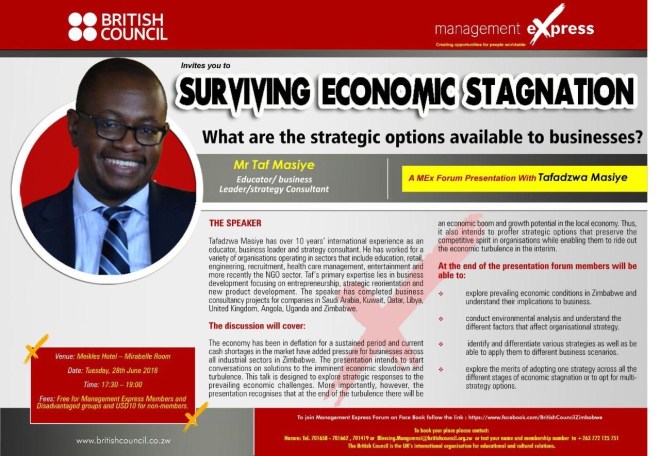
This post is a bit late, it was meant to accompany a cycle of seminars I facilitated for the British Council in Zimbabwe ith the end of June. Since nothing has change for th better in Zimbabwe I feel this post is still releveant if not more relevant now than in June.
img_76161

Stagnation in an economy is generally characterised by a major catastrophe which then gives birth to several challenges for business. The catastrophe is the case of Zimbabwe is up for contention. From a purely business point of view we can point to the imbalance between imports and export and from this point we can either go forwards or backwards to find the cause or effect of this imbalance. Some will argue that the imbalance comes from high cost of production which makes Zimbabwean products expensive on the global market while others will say low levels innovation and creativity have left Zimbabwe with little to export. Additionally falling prices in primary exports have greatly affected earning from exports. All these are true and we could possibly find more reasons at a push. So the situation we find the economy now is one that presents challenges for leaders of organisations to overcome. We are in an economy that is not making adequate amounts of new money, struggling to attract FDI while spending more on imports thereby putting pressure on liquidity in the market especially cash. Low levels of development in the banking sector and expensive banking products means alternatives to cash are inadequate or inaccessible to consumers. Banking in Zimbabwe is expensive as banks charge for service that are free elsewhere driving low level customers *majority* to keep cash in hand. Eventually imports drain cash to a point where even the cash in hand is dwindling affecting demand since consumers have not alternative to cash and retailers other services demand cash. Without cash or alternatives of cash simple transactions become impossible, demand falls, profit falls, prices could go up to buffer the effects of falling demand but this only adds pressure to demand creating an unending cycle. Well, there is an end the weakest fall first and the strongest last but not before creating monopolies and cartels.
The most important task for leadership is to know when to change, after that, it is knowing what to change and how to change it without compromising SURVIVAL. Many of us here are at this point we know that without corrective measures the businesses we run or work for are going to die. For some, employment has already died and companies too. I have put leadership forward for a reason, everything falls on leadership. Leadership is the Source of Mission, Vision. And Values (culture of the organisation) so leadership will be the champions of change with clear messages, decisions and direction. Change can be structured on the three windows of strategic planning
Where are? – Where do we want to go? How do we get there?
This process should be characterised by inclusion of all employees (everyone has a contribution to make). The TEAM then explores the options that are available. Depending on the chosen strategy preparing for the future in a market where real growth is possible starts as soon as we know that we can survive. Different organisations will require different strategies but what all organisations will need is a cultural shift. Being able to snap from survival mode to winning mode requires deliberate mental application led from the front by leadership. Training and development of staff is part of this strategy to re-orient staff from survival to winning. Leaders must train and develop too because they can only share what they know. When I first arrived in Zimbabwe in 2013 in the middle of an economic boom with a 13% growth rate a lot of the people went around saying “my CV should say I survived 2008”, that was a badge of honour and an achievement but 2013 wass 5 years from 2008!! We should have been selling different rhetoric at that point showing progression. The power of KNOWLEDGE is greatly undervalued in Zimbabwe. How many companies actively up skilled their staff in the 5 years post 2008?
Investing in Research and design as the starting point for Innovation in existing products and developing new products is imperative if the catastrophes of 2008 and 2016 are to be avoided in the future. Rather than importing let’s invest in developing production capabilities to make the things we need. Copy and paste if necessary and then adapt to suit the local needs. Research and development can also seep into capital equipment, modernisation or production lines will do wonders for efficiencies in an organisation. Delta invested million in its production lines post 2008, and the price of their products has fallen consistently without affecting their bottom line, indeed they company enjoys greater economies of scale now. Once we have attained these capabilities we can then move to expanding our markets look beyond the home market, find a competitive position and dedicate strategy to sink roots into a new market. Horticulture is doing it as we speak, the expertise is there, and learning opportunities are there.
The future is approach faster than you can imagine, don’t be caught out again!


The problem with unstructured entrepreneurship

This is probably more of a problem in Harare more than the other cities but the explosion of on-street vendors in the CBD is interesting and worrying at the same time. Surely there is some money to be made otherwise why would all these people congregate there every day but when we say there is money to be made. How much is enough?

The laws of economics dictate that ultra-competitive markets selling homogenous products have little to no profit for the players of the market. So, by all being in the same place the traders are pushing their own prices before the market even demands low prices. This is a perfect scenario for bargain hunters but not for the traders. What’s the solution?

Here is a radical idea! Instead of 25 vendors all sitting on the same street selling the same things how about we think smart and form cooperatives and use our collective resources to widen the product range, economies of scale to lower prices and sell more and ultimately make more money. By reducing competitiveness from the market the cooperatives will be able to claw back some power in terms of setting prices on the market. Tomatoes can gain 10-15% margin by simply selling from 1 sales point instead of 25 points. But what will the other 24 members of the cooperative do?

Well the cooperative will need to be structured. People will be allocated different roles to match their skill sets. The traders have already show they have skills in sourcing, pricing, market scanning, administration and a host of other skills needed to operate on the streets successfully enough to make a living from it. Some of these skills will not be obviously know to them but they are there they just need sign posting. People will earn consistent wages, partake in profit sharing and benefit from a collective pool of resources to expand the scope of their business.

Once the cooperative is fully functional it can then look into market expansion, taking on more members and developing a retail model that is sustainable and profitable. I foresee green grocers developing from this idea but can we convince the traders to formalize their operations?

What are some of the barriers to selling the cooperative idea?

Single mindedness of Zimbabweans in general
Lack of trust
Short term thinking
Lack of Resources to cover incomes in the short term
Lack of Organizational thinking

But most of these barriers can be easily overcome if there is desire and determination to break new ground.

What do you want from new leadership?

I have just read a blog from one of my workmates, as part of a vast empire that is as vast as the commonwealth we are getting ready to welcome a new leader. We are n old organisation and some parts of us have failed to evolve with the changing times in the orginsation and this blog has captured the frustraton of working with systems that are our of sync with the norms of today. Here are the five attributes they would like from the incoming leader,

1) Compassion

We are entering a time of devastation. Our lives and businesses will be strictly defined by the world’s biggest problems that have grown beyond our control. Our next leader will have to be extra sensitive to the ‘real’ and ‘big’ problems growing around us and have the heart to re-evaluate our cultural priorities. The rules of building trust and understanding between people are changing. He or she will have to write a few of them.

2) Sense of urgency

Our next leader will have to find a way to turn this ‘Oil Tanker’ or ‘Dinosaur’ (pick your choice) much much faster. We are several generations behind in our technology. We can’t afford to build massive products that take years to deploy. Our internal decision making processes need to allow us to act faster. He or she will have to act fast, fail fast and learn fast.

3) Disruptive thinking

Our next CEO will have to be a big risk taker. We have to admit that some of our current business models are failing and will be irrelevant within the next decade. He or she will have to do strategic planning for much longer than five years, and make radical changes which may affect our short term gains, but will make us relevant and successful in the next 50 years. He or she should be ready to make a few enemies.

4) Tech Evangelist

If he or she doesn’t have at least 1,000 twitter followers, I will be disappointed. If he or she is not a LinkedIn influencer, I’ll cry. If he or she uses a BlackBerry, I’ll probably resign. Our next leader must be able to not just use technology, but use it to engage with his or her staff, his customers and future customers one-to-one on a daily-basis.

5) Unifier

Our next front face will have to somehow find a way to unify our scattered organisation. He or she will have to find a way to bring his or her people – from around the world, stuck in different departments, working in their silos – together and harmonize our global offer. He or she must be able to see beyond the limits of geography and act as a global thinker, a world problem solver.

The next generation cultural leaders are not made from the old political ‘ambassador’ mould. The emerging cultural icons are the young and dynamic mavericks who engage with billions of people on a daily basis making extraordinary connections between people from the far corners of the world.

the frustration is not with outgoing eadership but they wish for the new leadership to look at the current state of the organisation, its customers’  and employees’ needs in order to shape their leadership for the next five years. Coming from a country where there are questions about the state of leadership I started wondering if people could make up their list of 5 attributes in the next leadership, what would they be?

Something resembling a normal market

Hello all, apologies for the long lay-off, i just didnt have time to sit and talk to you for a while but time flies when the world is moving along at crazy speads. It been 9 months in Zim! and I am still being amazed on a regular basis. As some of my African friends say, that’s Africa for you, the more things remain the same the more they change. I wish I knew what that actually means but change is creEping into some place here too.

So, in my many meetings with interesting and influential people here I discovered that the old establisment in the supermarket business is feeling the stress and pressure of a dynamic competitive market. Not long ago a Botswana entity called Choppies came into Bulawayo and all but took over the majoirty of Spar shops here then quickly set about bringing a different culture of doing business, competing for customers! Choppies did what any sound retailer would do, went around being a secret shopper and discovered that prices were high enough to be undercut by 5-15%, options could be increased and customer service was next to zero in this new market. They simply improved on those three things, lowered prices across the entire shop, added some variety in parts of the stock and inproved customer service by smiling more and asking to help. The results were astonishing especially to the old establishment whose sales began to fall with one major retail saying they went from selling $90-100k worth of groceries per day to $25K! Scary for them but easy pickings for Choppies. Now if only choppies could go elsewhere in Zimbabwe all shoppers would have an alternative and this would force change in the market as it has in Bulawayo. The old establishment are rushed off their feet tyring to catch up and hope that the customers will return to their shops to discover all the good things they are now doing but that is neither here nor there. Maybe for OK the Grand Challenge came at the right time. God! aren’t there many cars to be won at in the Grand Challenge! I was telling someone it used to be just one car to be won at the first Grand Challenge, now 35! or maybe even more. Anyway speaking of prices, I have just returned from England for a two week break and I dont know how this has happened but prices have been falling consistently in the shops, not just small drops but big drops like 10-20% in some products, even my office furniture suppliers has knocked of chunks from her prices. That $1 can of coke I complained so much about can now be found at 50c in some places but 65c almost every, that’s a 35-50% drop in price. I havent done a big food shop yet but I am sure there are drops in other things too, I know veggies are falling as farming goes from the tobacco and cotton to consumer produce in winter.

More perculiar stuff is in the banks, I have noticed there is one bank, METRO, that only opens on payday! and everytime I pass through that bank and there is a mile long queue of people waiting to be served I want ask them why they havent changed banks yet because clearly Metro can’t be giving them the service a bank is supposed to. It seems there is an agreement between public employers and the bank which can not be dissolved and the customers are locked in! And the perculiar stuff wouldn’t be complete without a contributions from Air Zimbabwe! So their Embraer jet which was servicing HRE-BYO-VFA-HRE-JNB has been recalled by its owner, guess who? Innscor the company that owns Chicken Inn and Nandos! but that’s not the perculiar part, those sectors it left are now being serviced by a boeing 767! an long range air craft that burns all the money it makes on those short trips in its take off fuel! the rest of the trip is being paid for by Air Zim! Why are they not wise enough to accpet that Air Zim can’t run an airline? Some months back there was a story about directors at the airline stealing 11m Euros from the company, at first I thought it was a lie, because, where would Air Zim get 11m Euros but it was true. That’s is the height of greed, how do the directors steal from a company with nothing, where would they work if it truly collapsed. One would have thought the directors would be working hard to turn around the airline until it was thriving and then steal from it!

So much to right about, I will collect my thoughts and write more in the days to come.

Top tip; spending 20 minutes in the morning sitting on the floor doing nothing, stop thinking until there is nothing active in your mind and your thoughts. Your thoughts in the rest of the day will be sharper and more successful in whatever you do but it takes time, to learn to be still for 20 minutes, pace yourselves!

Thin lines and tight margins!

It’s been a while since I wrote a piece for the blog and a lot has happened, frustrations, delight and sheer awe at the goings on in my day to day existence. I am also getting normalised or should that re-naturalised, so I am a little more patient and sometimes accepting to the stuff that drove me crazy in my first few weeks.

question-mark-nothing

I attended a child protection course and a university presentation in the last couple weeks ago both of which brief for moment it gave me a glimpse of what learning and training might be like in the Zimbabwean context. Without painting everyone with the same ugly brush, I would like to say that my experience with the learning environment has left me both shocked and sad at the state of environment in which the country is producing its workforce. On one hand the child protection trainer was well informed of his craft, policies and what not but he couldn’t teach it, we spent 2 hours listening and left without really being equipped with the “what is child abuse and what to do in the event of witnessing child abuse”. He was uncoordinated and lacked a road map of where the training started, what he needed to teach and where it ended.

Then, there was an in event at a local university and for the uninformed, Zimbabwe now has 16 universities! What I took out of the event is that in this part of the world observing protocol is everything even if it means repeating the honoured guests list 5 times at one event! It was tedious and boring after 2 rounds but to seat through 5 recitals of the list was too much especially for an event that was only two and half hours long. But, I learned something, if you don’t want to repeat honoured guest list in its entirety all you say is “All protocols observed”, so why we sat through the other stuff I don’t know. It’s not as if any new honoured guests were added to the list! But beyond that, the event again lacked simple preparedness, coordination and a sense of occasion, which was the point of it all.

I accept that I am quite sheltered in terms of experiencing the daily realities of living on meagre wages and general hardships that the common man and woman here go through but I had a “this is Africa moment” last week. I decided to explore the other side of the city on foot and encountered a market, now before you judge me let me finish! I have been to markets in other parts of Africa and in that hustle and bustle of the people’s market there is an experience that is uniquely Africa. PriceS of veggies goes from $1-3.00 in the shop to 30c – 70c and there are 10 to 15 traders seating next to each other selling exactly the same things and the same price. The products are primarily vegetables, clothes, cheap knock offs of sports shoes and even cheaper knock offs of leading electronics brands. But it was the atmosphere and the fading hope on the traders faces as I walked past each stall that stuck with me. My business brain quickly worked out that prices were so low because of hyper competition but could textbook strategy work here? What else would they traders do? The margins maybe as little as nothing but at least they have somewhere to go in the morning.

Today I visited a boarding school that benefits from my NGO’s support and found something that I remembered from the child protection training, Girls should not be beaten as punishment as school! I am sure there are many girls reading this who will remember being beaten and I saw it happening today! The irony of it all was that I was being shown around by a staff member who attended the child protection training I mentioned earlier and he didn’t notice it! The teacher was smacking the girls on their cheeks! Face cheeks! And in another corner were two boys who were missing lunch because their shoes had no laces! Which made me think, where does punishment and abuse become blurred lines? The lines are very thin….

This can’t be happening!!!

Another week and loads more experiences to talk about!

images

So this week I won’t complain about AirZim, even though it was the same old apologies routine from them. Unfortunately for me, I left my travel arrangements for the last minute and couldn’t get a seat from Harare to BYO so I booked myself onto Pathfinder. I have used it before and it went well so it wasn’t a terrible alternative to have. Well everything went as well as usual until 60kms from the destination. The bus ground to a halt and the attendant announced that there was a fault and the driver has gone to get a mechanic to get it fixed. Zimbabweans are a very patient bunch so we all waited waited without complaining and those that couldn’t wait got off the bus and jumped onto whatever stopped for them. I couldn’t bare the annoyance after the an hour and half so I asked for a number to call and rang everyone and their uncle at Pathfinder only to be told that the fault would be fixed in 20-30 minutes so we should wait! Never mind about a contingency plan should the mechanic fail to fix the fault. 2 hours later the driver comes back, pours diesel into the bus and off we went. Hang on!, did the bus just run out of diesel? Imagine that, the premier bus company in Zimbabwe which does 2 trips 2 times a day, everyday of the year and their bus runs out of diesel!!! How does that happen, Pathfinder?

And the big event of the week was some personal possessions of mine have finally arrived from England after sailing dates were cancelled, chopped and changed! They arrived in Namibia so my driver went to fetch my van laden with the said possessions and drove it to Plumtree. I had to meet him there so I could clear it and boy was it an education!!. The day was long, stressful and could have been expensive! Well it was expensive but could have been much worse. The first lesson was you need a good driver first of all, one who is well known at the border otherwise it could be 2-3 days there. Secondly, unlike what I had been told, claiming returning residency is not easy at all. You must prove all manner of things before they accept it so it’s not an option. Thirdly they don’t care what you say your vehicle is worth, it depends on what they find on Autotrader at that point that remotely resembles your car and is more expensive. The final lesson is even if you have been given the last stamp to get out, you can still be searched and be asked to pay more! You will need a lot of patience because you wait for everything and everyone! And you won’t make it anywhere without paying a bribe. Sometimes it’s the only way out and thank you to the officers at the border who took bribes from me, it was worth it!!! Yes, it does happen!

Lastly, some work related goings on. I have spent all week meeting people with potential projects for me to consider for funding and there is a death of meeting etiquette in this place. People don’t take serious shit seriously, I have grown tired of under dressed, under prepared and downright uninspiring people coming into share their dreams with me. The great shame is that some of the projects have a lot of potential. So I have been teaching people how to present themselves, their ideas and to think 360 degrees about the impact of their projects. Now, where else in the world would the person with the money tell them person who wants the money how to get the money? I want to help my kin folk but come on! Who do we blame though, for grossly under prepared graduates leaving university with degrees but little to offer the world? Is the government, the lecturers or the students? Why is this happening?

But it’s not all doom though, I have been compiling a catalogue so business opportunities for some of your to consider, I am just working on an investment vehicle that will manage the venture on behalf of investors. And, no! I don’t want to steal anyone’s money! You can keep your money if you don’t trust the scheme but there are areas in which a little investment and long term thinking can bring good returns to investors. We are capable of building businesses that are ethical and founded on trust. If you are into get rich quick, this won’t be for you.

This is Africa!

It’s been a month!, some times it has felt like a whole year and other times I have been left trying to catch my breath at being here. And on many occasions I have been told “chill out Taf, this is Africa!”. It’s funny how much of the africaness of Africa I had forgotten and the frustrations I have felt trying to change things to my suit my expectation especially with business contacts! So today to mark my one month in Africa I will share with you some “This is Africa” moments I have had so far, I hope I can remember them all!

thisisafrica

I suppose nothing about being in Africa screams it out as loud as remnants of colonialism and I stepped right back to Cecil J Rhodes’ days when I stopped at the Bulawayo Club. The nastiness of colonialism ain’t there any more, at least not visibly so. Just walking into the place made me go “WOW”, the wood panelled walls and resistance to modern norms was just amazing to see but the most peculiar thing about the Bulawayo Club is not the 1800s feel of the place but the fact that until 8 months ago women were not allowed in the bar! All women had to sit on the chairs outside the bar while their men drank from inside. Now if your history on Cecil J Rhodes is sound you might be able to understand why women weren’t allowed in a bar where gentlemen enjoyed each others company. That’s just my own conclusion! As of now women can enter the bar but must abide by a strict dress code, most of which sounds to me like no feminine sexuality allowed, still.

Because of business commitments in both Bulawayo and Harare I have done a fair bit of commuting on Air Zimbabwe between the cities. First of all, well done to AirZim for recognising that charging what people can afford puts bums on seats! Ever since the airline introduced the $61 one way ticket, flying is now a real option for many people. But, a big but! It is not OK to operate on the pretext that you can always apologise for being unprepared or under prepared? On every occasion that I have used the airline, 6 times in 30 days, they apologise for being late! How about making it an objective of everyone on a shift that you do everything possible so that you do not apologise for being let yet again. It is not OK to say sorry, not if you say it all the time!. There is an apologist mentality that allows for inadequate performance which must stop, SHAPE UP and do things right!

My imprisonment at the Holiday Inn came to an end a week ago, I was desperate to leave, nearly 4 weeks in hotels is no fun for anybody not least me with all my habits! I like what I like and after a week I had figure out I didnt like the long corridors of the hotel or the lack of choice in food, buffet every night is just laziness on the part of the chef or chefs! And at $26 at a time it’s daylight robbery. But its not just the Holiday Inn where things are inexplicably expensive, its everywhere! Now at the risk of sounding far removed from everyone’s reality here, beware, it’s my reality. Remember, I like what I like, so I went into a supermarket with a list of stuff to buy so I could make something to eat and this is what I found – 500G Mushrooms – $5.00, 500G Cucumber – $4.00, 12 Eggs – $2.50, 500G Butter – $6.50 (imported $12.00), 125G Cheese $3.55 and a non stick pan to make it all in $42.00. That has got to be the most expensive omelette you an make! Oh and the Plastic spatula to turn the omelette with $6.95! I have left a whole bunch of other stuff that added to my $195 trip to TM on my first day in my flat. Now I know regular families will not buy what I bought but still in a country where the average wage is $300, I am amazed the supermarkets sell anything at all. Even the less luxurious stuff is expensive but should it be?

Somewhere on this blog I once complained about timekeeping but that was just me on flying visits here. I have had to learn to tell time the Zimbabwean way. 3 minutes here is not three minutes at all whether it is social or business. 3 minutes ranges from 15 minutes to whatever minutes and even then you will still have to remind your appointment that you have been waiting for them since they said 3 minutes but it’s now 45 minutes. And, the will still say ” I am 3 minutes away!” When I make an issue about time, all I get is ” T.I.A – This is Africa”. But why do we accept it?

My last T.I.A moment was when I went to get satellite TV from DSTv. Forget phoning your provider, agreeing an installation time, they turn up with everything and when they leave you are connected. So I walk into their office and they sell me the set top box and they take my money for it but then tell me that for the subscription I must go to one of 7 banks and make a deposit then bring the deposit slip back to the office so that they could activate me. What about installation? “Well” say the least helpful front person ever “here is a list of 3rd party electricians that can do that for you if you have a satellite dish, if you don’t have a dish you should ask if the electiricans have dishes! But I have already paid for this other stuff and I am connected! The lady says “Well sir that’s how we do things here!” and I say “Fuck off this is rubbish, you are lucky no one can afford to give you competition otherwise you would be out of business!” I am the politest person in the world but they had pushed me too far. What did I pay for? I walked out dreading that I would not be able to watch the TV channels I had paid for but luckily I had a dish connected and didn’t need the engineers. But why do we put up with it?

Because this is Africa and I should stop trying to change this world because I will have a cardiac like the dear old English lady who has adopted me keeps telling me!

Maybe I am being naive!

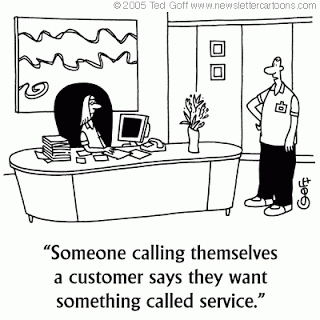
Over the last two weeks I have encountered different types of services, private and public and on all occasions I have been left wondering, “what is the reason behind this never ending relationship between customer service and the ball point pen in Zimbabwe?”. In almost all instances there is always a computer at every service desk! Sometimes both the pen and the computer are used to record the same event, meaning I have to wait twice as long to be served without any real improvement to my experience of that service.

Am I expecting too much, does anyone else not see that, for time and age that we are living in at this very moment, we are not equipped to be effective and efficient? One colleague reminded me that my problem is I have diaspora expectations, I should accept that things are different here but what is the real difficult in producing customer service provisions that exceed current levels? Surely it is not because investing in information technology is expensive, the technology is already there!. Could it be a lack of training or is it management myopia holding back the development of better service provision quality?

Here are two examples of why I am complaining, at my previous hotel, I had some dirty laundry washed, my details and the list of items to be washed where added onto my room information on the hotel’s computer system, later as I came to collect laundry I was asked to pay cash, even though this was midway through my stay, I produced the money to pay. Payment details were added onto my room information and a receipt book with ball point pen attached was produced to duplicate the very same information for which I was given a copy but only after a 20 minute wait. Upon checking out I was given a 4 page folio copy printed by the system detailing every single thing I had done that week including the laundry business! why do I need it again or why did I have to wait for all that 20 minutes in the first instance when I could have just got the information on checking out?!

The same goes to my mobile phone provider who made me wait in three queues to be saved at 3 desks in order to change my micro sim to a nano sim! on all three occasions I was asked to repeat the same information for which three different colour hand written receipts were produced while the information was simultaneously added onto the information technology system! After 45 minutes waiting for this elaborate process to be completed I got to the payment station and I was told the cashier didn’t have change for $20 so now I had to find that in order to pay! Life is way too short for this BS!

But all is not lost, as I discovered at Harare Airport where I arrived to check in for my flight to Bulawayo, my first with the airline for 14 years!, with nothing but an emailed e-ticket on my iphone. You can forgive the nervous ball of anxiety in my stomach as I got to the check-in desk but the helpful gentleman checked me in with a smile and without asking any further question or even an ID!

Isn’t it a scary world when anything related to AirZim is an example of best practise! Ahh, its supplier of handling services at the airport should get the applause instead, well done to the NHS for not using a ball point pen! (No!, it stands for National Handling Services, not that other NHS!). As for AirZim, we left on time, well 20 minutes late is no reason to complain when the national airline is the service provider on any trip!

I am sure some will have a counter point and an explantion or rationale for all my complaints, maybe I am just being naive but, come on!
bad-customer-service 2

Update from Zimbabwe

Hello world!

I-Love-Zimbabwe-T-Shirts

My first ever blog as UK returnee, that’s what people like me are called out here. Throw into that my work life and business life, its been an eye opening week. I have drifted into a new world here, I am now into art, culture, development work and value creation. It’s a fascinating departure from teaching global marketing strategy! But I am relishing the prospects of what is in store in both lives. I am getting to grips with working with limited amounts of very expensive internet, pay as you go calls, $2.55 tins of Heinz Baked Beans and $11 for 500g of Kerry Gold butter. The trip to the shops was a proper “shit just got real moment”. Actually that trip explained why nearly all fridges I open here are just water coolers!

But, from a business perspectives the prospects are seemingly unlimited. It’s just a matter of how innovative one is in identifying projects, financing them and planning that could be a limiting factor. Innovative and creative solutions to problems are few here. This market is very short term in its outlook, pricing is unrealistic with every business looking to make as much money as possible today. I feel its unsustainable in the long term especially if a new player enters the market with a different pricing strategy. It will take a shift in culture across all sectors to steer businesses towards a different perspective.

And the politics keeps everyone guessing but I suppose the less said about that the better, there is a lot of guessing to keep everyone entertained without me adding to the rumour mill! We all wait patiently, what other option do we really have? What is more fascinating for me is how politics influences areas that I had never thought could cause discomfort to the political agenda of the day! I have so much to learn here.

As for now I am sitting in a hotel room watching a TV on mute and listening to music as I write. This is going to be the hardest part of the transition, the darkness of the night consumes daylight by 1715 and time drags on slowly until morning. I have 13 channels of nothing I would like to watch and BBC iplayer seems to have been told I moved from England because it now says I am not allowed to watch stuff I have missed! I might need saving from myself soon!

The premiership is back, Arsene Wenger and Ivan Gazidis are lucky to be living in country where the people and regimes are tolerant, if it were a different country someone would have been shot by now. I will have more on everything next week, albeit from a different hotel room!

Enough already, there is such a thing as too many strategies!!!

So I have been getting a lot of links from Linked In about the top ten this and and top ten that. 1001 reasons why your business is not successful or 10 things to get your social media up and what not. I started thinking, who gives these people the right to know what these companies needs or not. It’s got to be impossible for one strategy consultant or expert to figure out the problems for one company let alone create a list that takes care of all other companies of the world. I am all for the sharing of ideas and expertise or even experiences but come on, there is no one list that can sort out to all marketing or strategy problems. I know I sound like I am ranting a little bit but maybe we should come up with concrete analysis and solutions on a wider scale, creating frameworks that can be applied to different countries in different industries. Porter’s five forces models hasn’t lasted this long by accident and it will continue to be used for a long time because it is solid and relevant across different era.

Now my problem with the occasional (fad) strategists is that their solutions to perceived problems are all rather short term in scope because they all come up with more things you can improve at such a fast pace that the initial solutions aren’t even been given time to fail. I suppose it’s all down to the constant changes on the internet or maybe I should try some of the tips instead of mourning about them, but then, where is the fun in that?!

Hopefully a more substantial post will come next week, something about China and a skills gap there caught my eye. Would you go to work in China? But, the real question is how come a country with the largest population in the world and one that supplies the most number of foreign students to all the education destinations has shortage of skilled labour?!