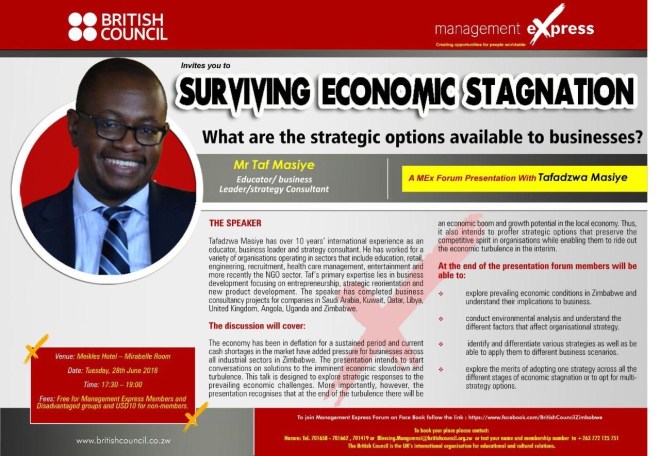
This post is a bit late, it was meant to accompany a cycle of seminars I facilitated for the British Council in Zimbabwe ith the end of June. Since nothing has change for th better in Zimbabwe I feel this post is still releveant if not more relevant now than in June.
Stagnation in an economy is generally characterised by a major catastrophe which then gives birth to several challenges for business. The catastrophe is the case of Zimbabwe is up for contention. From a purely business point of view we can point to the imbalance between imports and export and from this point we can either go forwards or backwards to find the cause or effect of this imbalance. Some will argue that the imbalance comes from high cost of production which makes Zimbabwean products expensive on the global market while others will say low levels innovation and creativity have left Zimbabwe with little to export. Additionally falling prices in primary exports have greatly affected earning from exports. All these are true and we could possibly find more reasons at a push. So the situation we find the economy now is one that presents challenges for leaders of organisations to overcome. We are in an economy that is not making adequate amounts of new money, struggling to attract FDI while spending more on imports thereby putting pressure on liquidity in the market especially cash. Low levels of development in the banking sector and expensive banking products means alternatives to cash are inadequate or inaccessible to consumers. Banking in Zimbabwe is expensive as banks charge for service that are free elsewhere driving low level customers *majority* to keep cash in hand. Eventually imports drain cash to a point where even the cash in hand is dwindling affecting demand since consumers have not alternative to cash and retailers other services demand cash. Without cash or alternatives of cash simple transactions become impossible, demand falls, profit falls, prices could go up to buffer the effects of falling demand but this only adds pressure to demand creating an unending cycle. Well, there is an end the weakest fall first and the strongest last but not before creating monopolies and cartels.
The most important task for leadership is to know when to change, after that, it is knowing what to change and how to change it without compromising SURVIVAL. Many of us here are at this point we know that without corrective measures the businesses we run or work for are going to die. For some, employment has already died and companies too. I have put leadership forward for a reason, everything falls on leadership. Leadership is the Source of Mission, Vision. And Values (culture of the organisation) so leadership will be the champions of change with clear messages, decisions and direction. Change can be structured on the three windows of strategic planning
Where are? – Where do we want to go? How do we get there?
This process should be characterised by inclusion of all employees (everyone has a contribution to make). The TEAM then explores the options that are available. Depending on the chosen strategy preparing for the future in a market where real growth is possible starts as soon as we know that we can survive. Different organisations will require different strategies but what all organisations will need is a cultural shift. Being able to snap from survival mode to winning mode requires deliberate mental application led from the front by leadership. Training and development of staff is part of this strategy to re-orient staff from survival to winning. Leaders must train and develop too because they can only share what they know. When I first arrived in Zimbabwe in 2013 in the middle of an economic boom with a 13% growth rate a lot of the people went around saying “my CV should say I survived 2008”, that was a badge of honour and an achievement but 2013 wass 5 years from 2008!! We should have been selling different rhetoric at that point showing progression. The power of KNOWLEDGE is greatly undervalued in Zimbabwe. How many companies actively up skilled their staff in the 5 years post 2008?
Investing in Research and design as the starting point for Innovation in existing products and developing new products is imperative if the catastrophes of 2008 and 2016 are to be avoided in the future. Rather than importing let’s invest in developing production capabilities to make the things we need. Copy and paste if necessary and then adapt to suit the local needs. Research and development can also seep into capital equipment, modernisation or production lines will do wonders for efficiencies in an organisation. Delta invested million in its production lines post 2008, and the price of their products has fallen consistently without affecting their bottom line, indeed they company enjoys greater economies of scale now. Once we have attained these capabilities we can then move to expanding our markets look beyond the home market, find a competitive position and dedicate strategy to sink roots into a new market. Horticulture is doing it as we speak, the expertise is there, and learning opportunities are there.
The future is approach faster than you can imagine, don’t be caught out again!
 Taf Masiye