The problem with unstructured entrepreneurship

This is probably more of a problem in Harare more than the other cities but the explosion of on-street vendors in the CBD is interesting and worrying at the same time. Surely there is some money to be made otherwise why would all these people congregate there every day but when we say there is money to be made. How much is enough?

The laws of economics dictate that ultra-competitive markets selling homogenous products have little to no profit for the players of the market. So, by all being in the same place the traders are pushing their own prices before the market even demands low prices. This is a perfect scenario for bargain hunters but not for the traders. What’s the solution?

Here is a radical idea! Instead of 25 vendors all sitting on the same street selling the same things how about we think smart and form cooperatives and use our collective resources to widen the product range, economies of scale to lower prices and sell more and ultimately make more money. By reducing competitiveness from the market the cooperatives will be able to claw back some power in terms of setting prices on the market. Tomatoes can gain 10-15% margin by simply selling from 1 sales point instead of 25 points. But what will the other 24 members of the cooperative do?

Well the cooperative will need to be structured. People will be allocated different roles to match their skill sets. The traders have already show they have skills in sourcing, pricing, market scanning, administration and a host of other skills needed to operate on the streets successfully enough to make a living from it. Some of these skills will not be obviously know to them but they are there they just need sign posting. People will earn consistent wages, partake in profit sharing and benefit from a collective pool of resources to expand the scope of their business.

Once the cooperative is fully functional it can then look into market expansion, taking on more members and developing a retail model that is sustainable and profitable. I foresee green grocers developing from this idea but can we convince the traders to formalize their operations?

What are some of the barriers to selling the cooperative idea?

Single mindedness of Zimbabweans in general
Lack of trust
Short term thinking
Lack of Resources to cover incomes in the short term
Lack of Organizational thinking

But most of these barriers can be easily overcome if there is desire and determination to break new ground.

Maybe I am being naive!

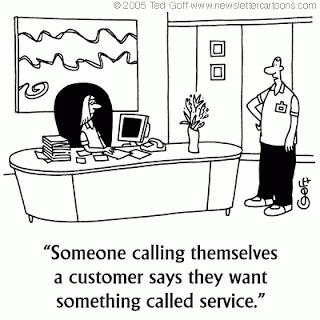
Over the last two weeks I have encountered different types of services, private and public and on all occasions I have been left wondering, “what is the reason behind this never ending relationship between customer service and the ball point pen in Zimbabwe?”. In almost all instances there is always a computer at every service desk! Sometimes both the pen and the computer are used to record the same event, meaning I have to wait twice as long to be served without any real improvement to my experience of that service.

Am I expecting too much, does anyone else not see that, for time and age that we are living in at this very moment, we are not equipped to be effective and efficient? One colleague reminded me that my problem is I have diaspora expectations, I should accept that things are different here but what is the real difficult in producing customer service provisions that exceed current levels? Surely it is not because investing in information technology is expensive, the technology is already there!. Could it be a lack of training or is it management myopia holding back the development of better service provision quality?

Here are two examples of why I am complaining, at my previous hotel, I had some dirty laundry washed, my details and the list of items to be washed where added onto my room information on the hotel’s computer system, later as I came to collect laundry I was asked to pay cash, even though this was midway through my stay, I produced the money to pay. Payment details were added onto my room information and a receipt book with ball point pen attached was produced to duplicate the very same information for which I was given a copy but only after a 20 minute wait. Upon checking out I was given a 4 page folio copy printed by the system detailing every single thing I had done that week including the laundry business! why do I need it again or why did I have to wait for all that 20 minutes in the first instance when I could have just got the information on checking out?!

The same goes to my mobile phone provider who made me wait in three queues to be saved at 3 desks in order to change my micro sim to a nano sim! on all three occasions I was asked to repeat the same information for which three different colour hand written receipts were produced while the information was simultaneously added onto the information technology system! After 45 minutes waiting for this elaborate process to be completed I got to the payment station and I was told the cashier didn’t have change for $20 so now I had to find that in order to pay! Life is way too short for this BS!

But all is not lost, as I discovered at Harare Airport where I arrived to check in for my flight to Bulawayo, my first with the airline for 14 years!, with nothing but an emailed e-ticket on my iphone. You can forgive the nervous ball of anxiety in my stomach as I got to the check-in desk but the helpful gentleman checked me in with a smile and without asking any further question or even an ID!

Isn’t it a scary world when anything related to AirZim is an example of best practise! Ahh, its supplier of handling services at the airport should get the applause instead, well done to the NHS for not using a ball point pen! (No!, it stands for National Handling Services, not that other NHS!). As for AirZim, we left on time, well 20 minutes late is no reason to complain when the national airline is the service provider on any trip!

I am sure some will have a counter point and an explantion or rationale for all my complaints, maybe I am just being naive but, come on!
bad-customer-service 2

Fastest growing consumer market

An October 2012 report by McKinsey Quarterly suggests that Africa is the fastest growing consumer market with more upward mobility up the consumer chain than traditionally wealthy markets like Japan.

africa economy

Now I know some of you will at this point, direct me to the fact that Japan is one country and Africa is a sum of countries. But, let story develop. If you look at it from a market perspective, a market can be without boarders and so the comparisons can work. The findings from the continent wide research also found that not all of Africa is experiencing this upward mobility in fortunes it is in the traditionally strong Africa economies like South Africa, Nigeria, Egypt and Morocco. While this is likely dampen any positive feelings about the potential for other African countries, I feel there is new opportunities littered everywhere in Africa for companies selling consumer goods.

The consumer population is growing with the number of people dependent on every working person falling every year meaning more people are earning an income and while they might not have a lot of disposable income, there will need basics and that’s where good market scouting can produce fantastic business opportunities for companies. Manufacturing will probably create the greatest profit margins but imports will probably out strip locally produced consumer products in terms of supply on the market. There is a need to recognise that Africa must add value to more of its produce because we are exporting crude oil and importing petrol and diesel, exporting cotton and importing clothes, exporting cocoa beans and importing chocolates  all which a more expensive than we got paid for the raw materials we exported.

While investment might be an issue when it comes to developing the capabilities to add value to raw materials, I feel the bigger issue is show term thinking amongst businesses in Africa because they a focussed on making a much money as possible it is impossible to go for cumulative approach in developing capabilities. So rather than thinking of building fully fledged manufacturing operations perhaps companies can consider building capacity gradually until they reach desired production level. This process will put less pressure on required investment and allow companies to develop efficient businesses that grow organically over time which is how all developed economies grew because they also developed through expansion in response to growing demand from their home markets.

So the opportunity is there for African economies to grow on the strength of their own demand but competition from foreign companies exporting cheaper product will also grow in response to the grow consumer market, how we overcome that and grow African enterprises will define the future of our economies. It’s my opinion that a long term strategy to growth, prudent profit margins, capacity building will deliver the potential being described by the report

Defining customers service in Africa; route towards improvement in customer service

Being a regular visitor to Africa in the last 11 months I have experienced varying degrees of customer service quality and concluded that getting “good” quality customer service is still a far fetched dream in almost all service encounters.

A few other travelling colleagues have been discussing how we could drive Africa towards universal good customers service as some research has identified Africa as a future destination for western companies looking to outsource customer service functions to African countries. There are several implications to finding a solution to customer service delivery in Africa, first of which is creating better experiences for customers and improving customer retention. Secondly if Africa is to realise the potential expressed in the above research referred then we need to have a marketable product by ensuring that every customer encounter with service delivery is positive, because you never know who your next customer might be.

It is my opinion that the process of improving African customer service provision must start with developing a clear understanding of how customer service is perceived in the Africa context. The lack of resources, imbalance between demand and supplier in many service encounters means that the supplier usually has an upper hand in most encounters thus removing the obligation on their part to be good to the customer who is dependent on them. This is in total contrast to environments where supply outstrips demand and so companies’ service provision is obliged to treat the customer as “king” in order to retain their custom. This reality of the service encounter in Africa reduces the customers’ bargaining power and potential to switch to an alternative source for either product or service. In the end the African customer feels obliged to accept sub standard customer service as a means to an end.

African private enterprise has substantially better service delivery than public service especially government services like passport offices, registration of births and deaths, medical service and any other essential services that a customer might expect from the government. Perhaps customer service personnel in public service offices do not even regard the people they serve as customers, which then removes the need for “good” customer service. Private enterprise on the other hand recognises the relationship it has with the people they service but greater demand than supplier reduces the impetus to provide “good” customer service.

My conclusion is that there is need for cultural re-orientation to get the customer to demand “good” customer service and service providers from both public and private sectors to view customers as opportunities to create relationships that will continue positively beyond each service encounter. This change will require leadership in both private and public sectors, training and adoption of clearly defined performance parameters supported by systematic evaluation. But the starting point must be a review and analysis of prevailing perceptions of “good” customer service to the provider and customer in Africa.

What should companies use Facebook for?


Much of the hype behind the actual value of Facebook was to an extent based on the business potential of the site in terms of it being used as a market platform for companies. But, a big but, the transformation of facebook from being a free service for individual user to a site that companies use to target the free service users has many obstacles to over come, firstly how will customers react to deliberate commercialisation of their social capital? there are lessons to learn from the experiences at myspace and capitalisation of social interaction, it didn’t work too well. The next question is how can companies guarantee that their investment will receive coverage that justifies the expanditure on advertising on facebook? There are already several conspiracy theories regarding coverage, exposure and publicity limitations being imposed, randomly or otherwise, by facebook. So, investment on advertising might only produce a fraction of expected market outcomes afterall.

My reservations against the investment in advertsing on Facebook, as shared by www.larrykwirirai.com, are based on two observations, one of which is that marketers are being opportunistic in trying to convert social interaction into commercial capital. And, the other is that, without complete control if this process, since Facebook will manage all the analytics, there are serious strategic gaps that bring up red flags to observers.

I personally think any company looking to use Facebook as an out and out marketing platform to sell products need to fire their marketing team. Selling and overtly capitalist conduct goes against the whole ethos of social media!. Facebook should be a relationship building platform used to develop brand affinity and general communications while giving customers access into the organisation. It’s all about interaction and whether or not this leads to increased sales is dependent on the use of the data gathered via these interactions with customers and strategic capability of the marketing department to convert brand awareness into brand loyalty.

Just because Facebook has hundreds of millions of people to sell things to doesn’t mean marketers should be lazy, there is still the need to be creative be proactive in responding to customers needs if marketers are to successfuly sell their products while using Facebook as part of an effective marketing strategy!

Are we all marketers now?

The increasing use of technology and the sharing opinions that comes with that has shifted the marketing powerbase somewhat in the recent past. There was once a time when consumers relied on marketers’ information to know about the product, how it performs but never about its faults because marketers kept a tight control on such information as it could have a negative impact on sales. Now, however, the consumer has unlimited access to all the good information and also the stuff the producers wouldn’t want consumers to know because we are sharing information about anything and everything. I no longer read product manuals anymore, I google the product and let other people tell me how by product works, how to fix problems and even how to hack the product to get additional perofmance. That is the beauty of social media but what is the impact on companies and their marketing departments? how do they react to uncontrolled opinion sharing? should they even try to control and influence social opinion?

The article below asks there question and then tries to answer them, let me know what you think as well

https://www.mckinseyquarterly.com/Marketing/Digital_Marketing/Were_all_marketers_now_2834