Thin lines and tight margins!

It’s been a while since I wrote a piece for the blog and a lot has happened, frustrations, delight and sheer awe at the goings on in my day to day existence. I am also getting normalised or should that re-naturalised, so I am a little more patient and sometimes accepting to the stuff that drove me crazy in my first few weeks.

question-mark-nothing

I attended a child protection course and a university presentation in the last couple weeks ago both of which brief for moment it gave me a glimpse of what learning and training might be like in the Zimbabwean context. Without painting everyone with the same ugly brush, I would like to say that my experience with the learning environment has left me both shocked and sad at the state of environment in which the country is producing its workforce. On one hand the child protection trainer was well informed of his craft, policies and what not but he couldn’t teach it, we spent 2 hours listening and left without really being equipped with the “what is child abuse and what to do in the event of witnessing child abuse”. He was uncoordinated and lacked a road map of where the training started, what he needed to teach and where it ended.

Then, there was an in event at a local university and for the uninformed, Zimbabwe now has 16 universities! What I took out of the event is that in this part of the world observing protocol is everything even if it means repeating the honoured guests list 5 times at one event! It was tedious and boring after 2 rounds but to seat through 5 recitals of the list was too much especially for an event that was only two and half hours long. But, I learned something, if you don’t want to repeat honoured guest list in its entirety all you say is “All protocols observed”, so why we sat through the other stuff I don’t know. It’s not as if any new honoured guests were added to the list! But beyond that, the event again lacked simple preparedness, coordination and a sense of occasion, which was the point of it all.

I accept that I am quite sheltered in terms of experiencing the daily realities of living on meagre wages and general hardships that the common man and woman here go through but I had a “this is Africa moment” last week. I decided to explore the other side of the city on foot and encountered a market, now before you judge me let me finish! I have been to markets in other parts of Africa and in that hustle and bustle of the people’s market there is an experience that is uniquely Africa. PriceS of veggies goes from $1-3.00 in the shop to 30c – 70c and there are 10 to 15 traders seating next to each other selling exactly the same things and the same price. The products are primarily vegetables, clothes, cheap knock offs of sports shoes and even cheaper knock offs of leading electronics brands. But it was the atmosphere and the fading hope on the traders faces as I walked past each stall that stuck with me. My business brain quickly worked out that prices were so low because of hyper competition but could textbook strategy work here? What else would they traders do? The margins maybe as little as nothing but at least they have somewhere to go in the morning.

Today I visited a boarding school that benefits from my NGO’s support and found something that I remembered from the child protection training, Girls should not be beaten as punishment as school! I am sure there are many girls reading this who will remember being beaten and I saw it happening today! The irony of it all was that I was being shown around by a staff member who attended the child protection training I mentioned earlier and he didn’t notice it! The teacher was smacking the girls on their cheeks! Face cheeks! And in another corner were two boys who were missing lunch because their shoes had no laces! Which made me think, where does punishment and abuse become blurred lines? The lines are very thin….
This is Africa!

It’s been a month!, some times it has felt like a whole year and other times I have been left trying to catch my breath at being here. And on many occasions I have been told “chill out Taf, this is Africa!”. It’s funny how much of the africaness of Africa I had forgotten and the frustrations I have felt trying to change things to my suit my expectation especially with business contacts! So today to mark my one month in Africa I will share with you some “This is Africa” moments I have had so far, I hope I can remember them all!

thisisafrica

I suppose nothing about being in Africa screams it out as loud as remnants of colonialism and I stepped right back to Cecil J Rhodes’ days when I stopped at the Bulawayo Club. The nastiness of colonialism ain’t there any more, at least not visibly so. Just walking into the place made me go “WOW”, the wood panelled walls and resistance to modern norms was just amazing to see but the most peculiar thing about the Bulawayo Club is not the 1800s feel of the place but the fact that until 8 months ago women were not allowed in the bar! All women had to sit on the chairs outside the bar while their men drank from inside. Now if your history on Cecil J Rhodes is sound you might be able to understand why women weren’t allowed in a bar where gentlemen enjoyed each others company. That’s just my own conclusion! As of now women can enter the bar but must abide by a strict dress code, most of which sounds to me like no feminine sexuality allowed, still.

Because of business commitments in both Bulawayo and Harare I have done a fair bit of commuting on Air Zimbabwe between the cities. First of all, well done to AirZim for recognising that charging what people can afford puts bums on seats! Ever since the airline introduced the $61 one way ticket, flying is now a real option for many people. But, a big but! It is not OK to operate on the pretext that you can always apologise for being unprepared or under prepared? On every occasion that I have used the airline, 6 times in 30 days, they apologise for being late! How about making it an objective of everyone on a shift that you do everything possible so that you do not apologise for being let yet again. It is not OK to say sorry, not if you say it all the time!. There is an apologist mentality that allows for inadequate performance which must stop, SHAPE UP and do things right!

My imprisonment at the Holiday Inn came to an end a week ago, I was desperate to leave, nearly 4 weeks in hotels is no fun for anybody not least me with all my habits! I like what I like and after a week I had figure out I didnt like the long corridors of the hotel or the lack of choice in food, buffet every night is just laziness on the part of the chef or chefs! And at $26 at a time it’s daylight robbery. But its not just the Holiday Inn where things are inexplicably expensive, its everywhere! Now at the risk of sounding far removed from everyone’s reality here, beware, it’s my reality. Remember, I like what I like, so I went into a supermarket with a list of stuff to buy so I could make something to eat and this is what I found – 500G Mushrooms – $5.00, 500G Cucumber – $4.00, 12 Eggs – $2.50, 500G Butter – $6.50 (imported $12.00), 125G Cheese $3.55 and a non stick pan to make it all in $42.00. That has got to be the most expensive omelette you an make! Oh and the Plastic spatula to turn the omelette with $6.95! I have left a whole bunch of other stuff that added to my $195 trip to TM on my first day in my flat. Now I know regular families will not buy what I bought but still in a country where the average wage is $300, I am amazed the supermarkets sell anything at all. Even the less luxurious stuff is expensive but should it be?

Somewhere on this blog I once complained about timekeeping but that was just me on flying visits here. I have had to learn to tell time the Zimbabwean way. 3 minutes here is not three minutes at all whether it is social or business. 3 minutes ranges from 15 minutes to whatever minutes and even then you will still have to remind your appointment that you have been waiting for them since they said 3 minutes but it’s now 45 minutes. And, the will still say ” I am 3 minutes away!” When I make an issue about time, all I get is ” T.I.A – This is Africa”. But why do we accept it?

My last T.I.A moment was when I went to get satellite TV from DSTv. Forget phoning your provider, agreeing an installation time, they turn up with everything and when they leave you are connected. So I walk into their office and they sell me the set top box and they take my money for it but then tell me that for the subscription I must go to one of 7 banks and make a deposit then bring the deposit slip back to the office so that they could activate me. What about installation? “Well” say the least helpful front person ever “here is a list of 3rd party electricians that can do that for you if you have a satellite dish, if you don’t have a dish you should ask if the electiricans have dishes! But I have already paid for this other stuff and I am connected! The lady says “Well sir that’s how we do things here!” and I say “Fuck off this is rubbish, you are lucky no one can afford to give you competition otherwise you would be out of business!” I am the politest person in the world but they had pushed me too far. What did I pay for? I walked out dreading that I would not be able to watch the TV channels I had paid for but luckily I had a dish connected and didn’t need the engineers. But why do we put up with it?

Because this is Africa and I should stop trying to change this world because I will have a cardiac like the dear old English lady who has adopted me keeps telling me!

Maybe I am being naive!

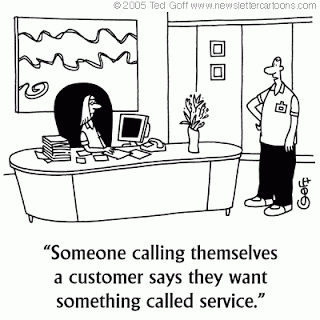
Over the last two weeks I have encountered different types of services, private and public and on all occasions I have been left wondering, “what is the reason behind this never ending relationship between customer service and the ball point pen in Zimbabwe?”. In almost all instances there is always a computer at every service desk! Sometimes both the pen and the computer are used to record the same event, meaning I have to wait twice as long to be served without any real improvement to my experience of that service.

Am I expecting too much, does anyone else not see that, for time and age that we are living in at this very moment, we are not equipped to be effective and efficient? One colleague reminded me that my problem is I have diaspora expectations, I should accept that things are different here but what is the real difficult in producing customer service provisions that exceed current levels? Surely it is not because investing in information technology is expensive, the technology is already there!. Could it be a lack of training or is it management myopia holding back the development of better service provision quality?

Here are two examples of why I am complaining, at my previous hotel, I had some dirty laundry washed, my details and the list of items to be washed where added onto my room information on the hotel’s computer system, later as I came to collect laundry I was asked to pay cash, even though this was midway through my stay, I produced the money to pay. Payment details were added onto my room information and a receipt book with ball point pen attached was produced to duplicate the very same information for which I was given a copy but only after a 20 minute wait. Upon checking out I was given a 4 page folio copy printed by the system detailing every single thing I had done that week including the laundry business! why do I need it again or why did I have to wait for all that 20 minutes in the first instance when I could have just got the information on checking out?!

The same goes to my mobile phone provider who made me wait in three queues to be saved at 3 desks in order to change my micro sim to a nano sim! on all three occasions I was asked to repeat the same information for which three different colour hand written receipts were produced while the information was simultaneously added onto the information technology system! After 45 minutes waiting for this elaborate process to be completed I got to the payment station and I was told the cashier didn’t have change for $20 so now I had to find that in order to pay! Life is way too short for this BS!

But all is not lost, as I discovered at Harare Airport where I arrived to check in for my flight to Bulawayo, my first with the airline for 14 years!, with nothing but an emailed e-ticket on my iphone. You can forgive the nervous ball of anxiety in my stomach as I got to the check-in desk but the helpful gentleman checked me in with a smile and without asking any further question or even an ID!

Isn’t it a scary world when anything related to AirZim is an example of best practise! Ahh, its supplier of handling services at the airport should get the applause instead, well done to the NHS for not using a ball point pen! (No!, it stands for National Handling Services, not that other NHS!). As for AirZim, we left on time, well 20 minutes late is no reason to complain when the national airline is the service provider on any trip!

I am sure some will have a counter point and an explantion or rationale for all my complaints, maybe I am just being naive but, come on!
bad-customer-service 2

Defining customers service in Africa; route towards improvement in customer service

Being a regular visitor to Africa in the last 11 months I have experienced varying degrees of customer service quality and concluded that getting “good” quality customer service is still a far fetched dream in almost all service encounters.

A few other travelling colleagues have been discussing how we could drive Africa towards universal good customers service as some research has identified Africa as a future destination for western companies looking to outsource customer service functions to African countries. There are several implications to finding a solution to customer service delivery in Africa, first of which is creating better experiences for customers and improving customer retention. Secondly if Africa is to realise the potential expressed in the above research referred then we need to have a marketable product by ensuring that every customer encounter with service delivery is positive, because you never know who your next customer might be.

It is my opinion that the process of improving African customer service provision must start with developing a clear understanding of how customer service is perceived in the Africa context. The lack of resources, imbalance between demand and supplier in many service encounters means that the supplier usually has an upper hand in most encounters thus removing the obligation on their part to be good to the customer who is dependent on them. This is in total contrast to environments where supply outstrips demand and so companies’ service provision is obliged to treat the customer as “king” in order to retain their custom. This reality of the service encounter in Africa reduces the customers’ bargaining power and potential to switch to an alternative source for either product or service. In the end the African customer feels obliged to accept sub standard customer service as a means to an end.

African private enterprise has substantially better service delivery than public service especially government services like passport offices, registration of births and deaths, medical service and any other essential services that a customer might expect from the government. Perhaps customer service personnel in public service offices do not even regard the people they serve as customers, which then removes the need for “good” customer service. Private enterprise on the other hand recognises the relationship it has with the people they service but greater demand than supplier reduces the impetus to provide “good” customer service.

My conclusion is that there is need for cultural re-orientation to get the customer to demand “good” customer service and service providers from both public and private sectors to view customers as opportunities to create relationships that will continue positively beyond each service encounter. This change will require leadership in both private and public sectors, training and adoption of clearly defined performance parameters supported by systematic evaluation. But the starting point must be a review and analysis of prevailing perceptions of “good” customer service to the provider and customer in Africa.

Really, is this what we were holding our breath for?

So the “let’s talk iPhone” event has come and passed, leaving some punters a little less satisfied than others because the expected iPhone 5 was not to be seen anywhere, instead all we got was the S version of the iPhone 4. Which got me thinking, what else have organisations pretended to bring to the market, creating hype in the market only to dissappoint with far less offerings when the launch happens.

Do we, as customers, now expect more than what the companies are capable of but if we do why do they not manage our expectations? Apple could have managed the anticipation for an iPhone 5 better. Some people, including myself, have waiting for a show stopper so that it would be our next smart phone but I am afraid I might have to look to other manufacturers for my next smart phone. I’ve had the iPhone4, Siri or no Siri I am looking for more especially at that price.

Apple has lost me and I bet more customers until the next iphone reincanation